Probably not yet, but the gap is smaller than the headlines suggest. AI booking agents can already find, compare and book hotels for guests in the US, and the UK is likely to follow. For most independent hotels, getting ready is less about new technology and more about doing the basics properly: a website machines can read, accurate rates everywhere, and a booking engine that is keeping up.
This guide covers what AI booking agents are, what they can do right now, how many UK guests are using them, and the practical steps to take with your website and your booking engine provider.
What are AI booking agents?
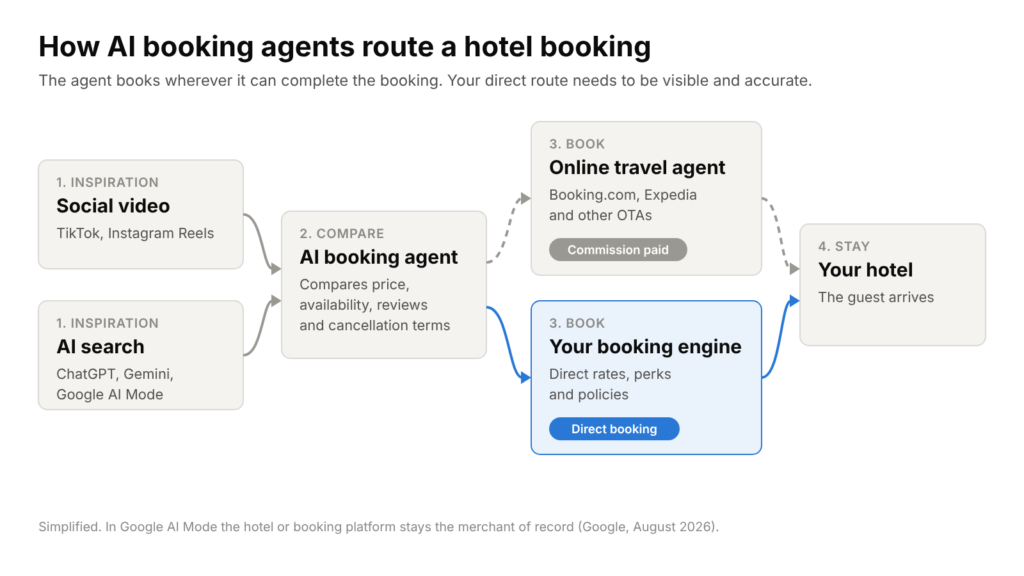
An AI booking agent is an AI tool that does more than recommend a hotel. It acts on the guest’s behalf: it checks availability, compares rates and room types, and takes the guest through to a booking without them visiting a string of websites.
That is the difference between AI search and AI booking. AI search (ChatGPT, Gemini, Google’s AI Overviews) decides which hotels get mentioned. AI booking agents decide where the booking actually happens. We covered the search side in From SEO to GEO: Is Your Hotel Ready for AI Search? This post is about the booking side.
For now, a person still confirms the booking. Google’s draft standard for agent-led hotel bookings states that bookings have to be finalised by a person through a trusted interface, unless the guest has given the agent permission to pay for them (Search Engine Journal).
What AI booking agents can do today (and what’s still coming)
Things have moved quickly in 2026. Here is where each development stands at the time of writing:
| Status | What | Who’s involved | Available in the UK? |
|---|---|---|---|
| Live | Hotel booking in Google AI Mode: guests describe their trip, pick a hotel and pay with Google Pay without leaving Google (rolling out from 27 August 2026) | Booking.com, Expedia, Hilton, IHG, Marriott, Wyndham and other large chains and OTAs | No, US in English only |
| Live | TikTok GO: discover and book hotels directly from TikTok videos (launched 12 May 2026) | Booking.com, Expedia, Trip.com and other travel platforms | No, US only |
| Live | Hotel apps inside ChatGPT, such as Accor and Wyndham, alongside apps from the big OTAs | Large hotel groups and OTAs | Varies by app |
| Being tested | Agentic hotel booking in Google, shown to a small percentage of US traffic | Booking Holdings, with Expedia, Marriott, Wyndham and IHG involved in development | No |
| Announced | Google’s Universal Commerce Protocol (UCP) for lodging: a draft standard for how AI agents check prices and availability and complete bookings. Google says it will use it to power AI Mode hotel booking “over the coming months” | Developed with Amadeus, Booking.com, Expedia, Hilton, Marriott and Trip.com | Not yet |
Two things stand out. Nothing here is live in the UK yet, and every launch partner is a large chain or an online travel agent (OTA). Independent hotels are not in the first wave.
There is some good news in the detail. Google says the hotel or booking platform stays the merchant of record (the business that takes the payment and owns the booking), and that taking part in its booking integration does not affect how properties or rates are ranked (Search Engine Journal).
How many UK guests actually book with AI?
Fewer than the hype suggests, but the number is growing. Ipsos research presented by James Bland in the Hotel Marketing Association webinar The Evolution and Future of the Hotel Guest Booking Journey (October 2026) found this in Q2 2026:
UK guests and AI, Q2 2026 (Ipsos)
38%
Have used AI for hotels
Of UK respondents had used an AI tool to find hotel options, plan a trip or book accommodation.
30%
Found hotels with AI
Had used AI to find hotel options.
20%
Booked with AI
Had used AI to book accommodation, up from 18% in Q1 2026.
Trust is the main brake. Only 15% of respondents in Q1 said AI-generated output was always trustworthy, although the share saying “frequently” or “always” rose from 39% to 45% between Q1 and Q2. ChatGPT’s growth in the UK is also slowing: its audience grew 106% in 2025, but only 10% between January and August 2026, reaching 20.3 million people (Ipsos iris).
In short, AI booking is real but early. You do not need to be at the cutting edge, because the tools are changing too quickly for that to be worth it. You do need to be ready when they arrive in the UK.
What this means for independent hotels
The risk for independents is not AI itself. It is that intermediaries plug into AI first.
OTAs already dominate online hotel research. Ipsos iris data shows Booking.com reached 19.4 million UK visitors in August 2026, and 59% of the time UK users spent on accommodation websites and apps went to OTAs rather than hotel brands. Every AI booking product launched so far has OTAs among its partners. If an AI agent can complete a booking through Booking.com but not through your website, it will book through Booking.com, and you pay the commission.
Price is the other pressure. Ipsos found in 2023 that a quarter of UK leisure travellers had already booked a flexible rate, then cancelled and rebooked when they found it cheaper. Of those who wouldn’t, most cited a lack of time or too much hassle, not a belief that it was unfair. An AI agent that watches prices removes both barriers. Rate accuracy and a clear reason to book direct will matter more, not less.
Social media is where the journey often starts. Many bookings come from an emotional moment, a video of a sea view or a roaring fire, while scrolling TikTok or Instagram. TikTok GO turns that moment into a booking, but its partners are OTAs. Strong social content that sends people to your own website, covered in our guide to using TikTok and Reels for hotel marketing, is still your best defence. If you want help with it, that’s what our hotel social media service is for.
How to get your hotel website ready for AI booking agents
AI booking agents need two things from your hotel: information they can read and trust, and a way to book. Your website delivers the first. The steps below are the groundwork.
1. Let AI crawlers in
A crawler is a program that reads websites on behalf of a search engine or AI tool. If yours are blocked, AI tools can’t read your site.
Google’s AI Overviews and AI Mode use the same Googlebot crawler as normal search, so if you appear in Google you are already readable there (Google Search Central). ChatGPT is different. OpenAI uses a crawler called OAI-SearchBot to find websites for ChatGPT search, and a separate one, GPTBot, to collect content for training its models (OpenAI). You can allow one and block the other.
Ask your developer to check your robots.txt file (the file that tells crawlers what they can and can’t read) and any security or firewall settings. Some hosting and security services block AI crawlers by default, so a site can be invisible to ChatGPT without anyone choosing that.
2. Add structured data that describes your hotel
Structured data (also called schema markup) is code that labels the facts on a page, such as your hotel’s name, address, star rating, amenities and check-in times, so machines can read them reliably. The schema.org Hotel type exists for this.
It is not a magic switch. Google says there is no special schema needed to appear in its AI features, and that structured data must match what is visible on the page (Google Search Central). Treat it as good practice that removes ambiguity, not a shortcut to AI visibility. Our AI search optimisation service covers this in more depth.
3. Keep your facts identical everywhere
AI tools build their picture of your hotel from many sources: your website, your Google Business Profile, OTA listings, review sites and social media. If your website says dogs are welcome and your Booking.com listing says they aren’t, an AI tool has to guess, or it leaves you out.
Check that your room types, amenities, policies, opening times and contact details match across every listing. Our guide to local SEO for hotels covers getting your Google Business Profile right.
4. Answer the questions guests actually ask
Guests ask AI tools full questions: “a dog-friendly hotel near the coast with parking and a good restaurant”. Your website should answer those questions in plain text, not hide them in a PDF or an image.
Write clear, specific answers on room, dining and location pages about parking, accessibility, pets, EV charging, breakfast times and cancellation terms. A well-built FAQ section helps here, as we explain in why adding FAQs can improve your hotel website’s SEO and bookings. You also don’t need to add special “AI files” to your site: Google says these aren’t required for its AI features.
5. Make the booking path fast on mobile
When AI sends a guest to your website, the visit is short and focused: they have already chosen you and want to book. A slow page, a confusing menu or a booking engine that breaks on a phone will lose that booking.
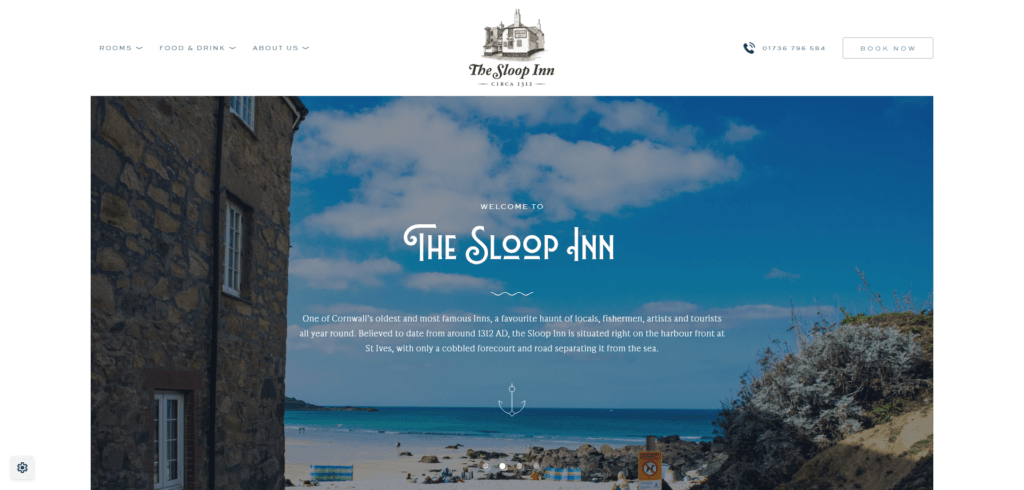
When we rebuilt the Sloop Inn’s website in St Ives, we built it mobile-first with simple navigation, and the inn received more than 600 enquiries in the first 30 days after launch.
Questions to ask your booking engine provider
When an AI agent books a room, it doesn’t use your website’s design. It uses the rates, availability and room data your booking engine sends out. That makes your booking engine provider one of the most important partners in getting ready for AI booking agents.
Most independent hotels can’t connect to Google or AI platforms directly. Their booking engine or channel manager does it for them. So ask your provider:
- Are our rates showing in Google’s free booking links? These are the free listings in Google’s hotel results that show where guests can book and at what price. Google says no one can buy better placement in them (Google Hotel Center Help). If your direct rate isn’t appearing, you’re leaving that space to the OTAs.
- How accurate are the rates and availability you send to Google and other channels? Inaccurate prices undermine trust with guests and with AI tools.
- What are your plans for Google’s AI Mode booking and the UCP lodging standard? Google has a waitlist for businesses, with onboarding details still to come. Ask whether your provider is on it.
- Do you connect, or plan to connect, to ChatGPT, Claude or other AI apps?
- Can an AI agent see our full offer? That means room types, cancellation policies, extras and packages, not just a headline price.
- How will bookings from AI channels be tracked and reported? If you can’t measure it, you can’t judge whether it’s working.
If your provider has no answers yet, that’s useful to know. It might be time to compare providers before AI booking reaches the UK, not after.
Not sure your website is keeping up?
Our hotel website support plans include ongoing checks on your website and booking engine, so problems are caught before they cost you bookings.
Give guests (and their agents) a reason to book direct
An AI agent comparing options will look at price, flexibility and what’s included. Make sure your website states clearly and in plain text why booking direct is better:
- Best rate: if your direct rate is the lowest, say so on the page.
- Perks: breakfast, late checkout, parking, a welcome drink. These only count if they’re written down where a guest, or an agent, can see them.
- Flexible terms: clear cancellation and amendment policies.
- Personal service: an easy route for special requests, such as connecting rooms, dogs, celebrations or group bookings. These are the conversations an OTA or AI agent can’t handle well.
- Extras: spa treatments, dinner packages and experiences that make the stay worth more than the room price.
The hotels that do best will be the ones where the direct booking is the better deal, and where that’s easy for anyone, or anything, to see.
Get your hotel website ready with Arise
AI booking agents aren’t taking over UK hotel bookings yet, but the groundwork takes time and the big brands and OTAs are already ahead. Start with a website that machines can read, facts that match everywhere, a fast mobile booking path and a booking engine provider with a plan.
Our team designs and builds hotel websites that drive direct bookings, and we can review how ready your current site is for AI search and AI booking.
Is your hotel website ready for AI booking?
We'll review how ready your site is for AI search and AI booking agents, and give you honest, practical advice on what to fix first. No hard sell.